Featured partner
Recommended for Guildford

ROAVR Group
Tree, ecology, flood risk and topographical surveys for planning applications.
4.9 Google rating
Get a quote
Local experts.
Featured partner
Recommended for Guildford
Tree, ecology, flood risk and topographical surveys for planning applications.
4.9 Google rating
Local experts.
Environmental consultancy founded in 2004, with its head office on the Surrey Research…
Multi-disciplinary practice founded in 1985, offering arboriculture, ecology, landscape…
Ecology consultancy based in Cranleigh that specialises in bat surveys, with habitat…
Independent ecological consultancy with a Surrey office near Farnham, plus offices in…
A bat survey checks whether bats roost in, or use, buildings, trees or habitats a development would affect. It starts with a preliminary roost assessment and, where needed, follow-up surveys at dusk or dawn in the active season. In Guildford, the local planning authority is Guildford Borough Council. Its 2023 Development Management Policies require lighting schemes to avoid light spill into habitats, and expect new buildings to include features for species such as bats. Wooded, riverside and older built settings are common here: the Wey Navigation and River Wey corridor, council woodland such as Chantry Wood, and darker parts of the Surrey Hills, where Policy D12 resists light pollution. All British bats and their roosts are legally protected.
Local planning authority: Guildford Borough Council
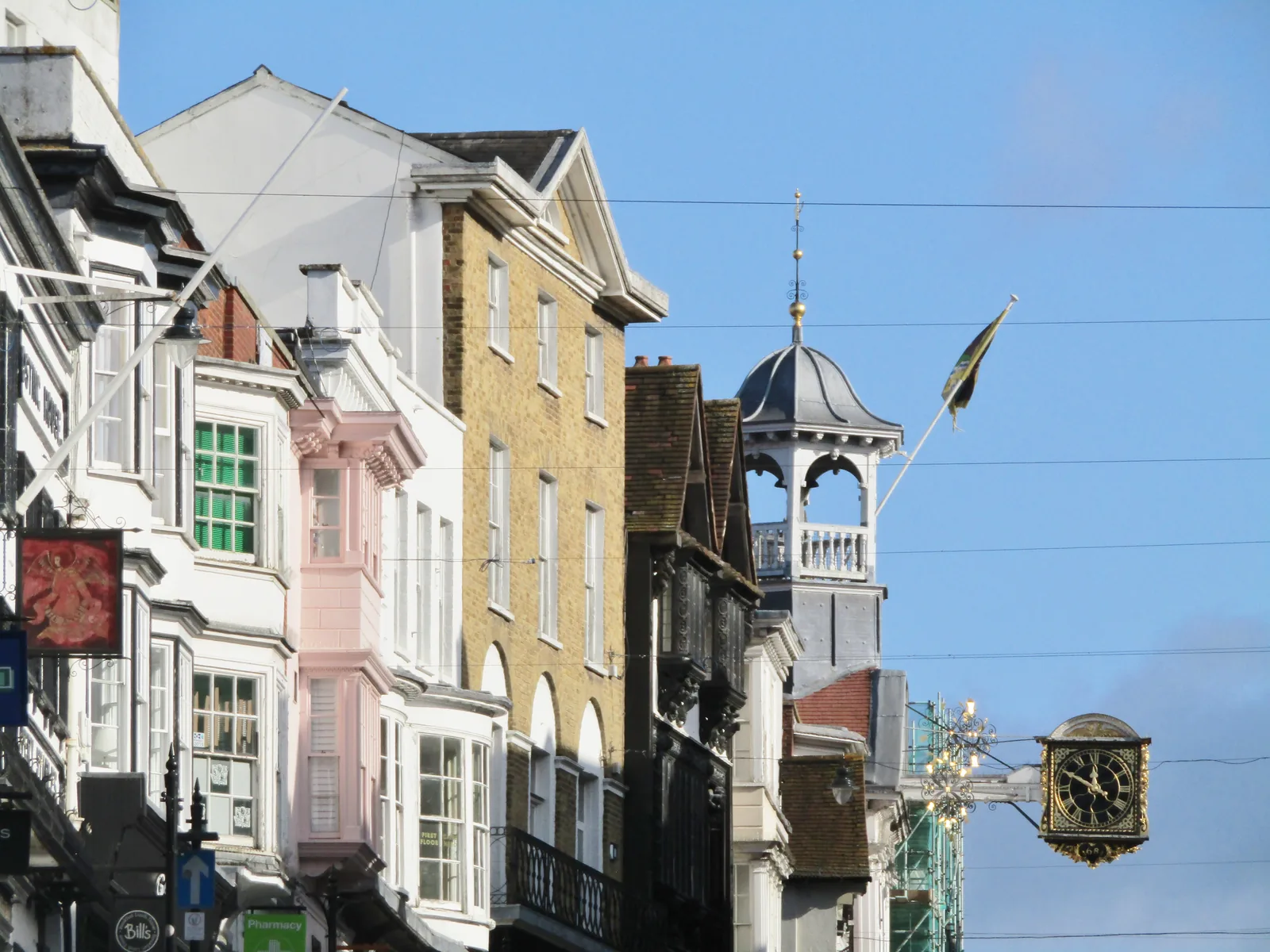
Bats in Guildford use a landscape that suits them: the River Wey and Wey Navigation give a long, continuous corridor for foraging and commuting through the town, and the council's Policy D13 notes that banks, towpaths, hedgerows, walls and bridges along the Navigations all offer opportunities for wildlife. South of the town, woodland at Chantry Wood and the wooded downs of the Surrey Hills add roosting and feeding habitat, and Policy D12 gives extra protection to darker skies there. Older buildings in conservation areas such as Millmead and Portsmouth Road Conservation Area, barns in the Metropolitan Green Belt villages, and mature trees are the usual places a roost assessment is needed.
Guildford Borough Council deals with bats mainly through the Local Plan: Development Management Policies (2023). Policy P6 requires priority species and habitats to be protected and enhanced through the mitigation hierarchy. Policy D12 requires a Light Impact Assessment for light-generating development, bars unacceptable light spill into habitats and their buffers, and resists light pollution in darker parts of the Surrey Hills; its supporting text points to the Institute of Lighting Professionals and Bat Conservation Trust guidance on bats and artificial lighting. Policy P7 requires new buildings to include lasting features for species such as bats. The council's validation list asks for a biodiversity assessment where protected species are known or likely to be present.
Local plan: Guildford Borough Local Plan: Strategy and Sites (2019) and Development Management Policies (2023) (Adopted. A new-style Guildford Local Plan is being prepared (timetable published 5 June 2026; planned adoption 30 April 2029) and will replace both parts.)
P1: Surrey Hills Area of Outstanding Natural Beauty and Area of Great Landscape Value
Conserves and enhances the AONB, presumes against major development there, and protects its setting; the AGLV is kept until the AONB boundary review ends.
D1: Place shaping
Overarching design and place-making policy (not specific to surveys).
D13: The Corridor of The River Wey & Godalming Navigations
Development affecting the Navigations must conserve their character, setting, ecology and heritage and integrate flood mitigation sensitively.
D12: Light Impacts and Dark Skies
Lighting schemes need a Light Impact Assessment covering wildlife; light spill into habitats and buffers must be avoided; extra protection in darker parts of the Surrey Hills.
D20: Conservation Areas
Development in conservation areas must preserve or enhance their character (title verified; detailed wording not re-read for this pack).
ID4: Green and blue infrastructure
Protects SPAs/SACs, SSSIs, SNCIs and Local Nature Reserves; seeks biodiversity gains, especially in Biodiversity Opportunity Areas; protects watercourse corridors.
P10: Water Quality, Waterbodies and Riparian Corridors
No deterioration of waterbodies; an undeveloped buffer of at least 10m from the top of bank on both sides of a main river, with a Landscape and Ecological Management Plan; no new culverting.
P11: Sustainable Surface Water Management
Greenfield run-off rates for greenfield sites; as close as practicable on brownfield; maximise permeable surfaces; follow the SuDS hierarchy and Surrey LLFA guidance; infiltration needs 1m clearance above groundwater.
P2: Green Belt
Inappropriate development in the Metropolitan Green Belt is refused unless very special circumstances exist; defines how extensions and replacement buildings are judged.
P4: Flooding, flood risk and groundwater protection zones
Development in medium/high flood risk areas needs a site-specific FRA, sequential/exception tests and safe access; undeveloped flood zone 3b is safeguarded; all schemes must show no increase in run-off and prioritise SuDS; protects Source Protection Zones.
P5: Thames Basin Heaths Special Protection Area
No net new homes within 400m of the SPA; new homes within 400m–5km must provide SANG and SAMM; schemes of 50+ homes at 5–7km assessed case by case.
P6: Protecting Important Habitats and Species
Protects irreplaceable and priority habitats and species; where ancient woodland is in or next to a site, a BS5837 survey locating ancient/veteran trees and a buffer of at least 15m are required.
P7: Biodiversity in New Developments
The adopted policy text sought at least 20% biodiversity net gain using the national metric, with gains secured for 30+ years, maximum on-site gain and features for wildlife on buildings. Following the National Planning Policy Framework published on 17 August 2026 the statutory 10% minimum applies except where a higher figure is justified on a specific site allocation.
General guidance for bat survey, not formal advice for your site.
When protected species are known or likely to be present, which includes buildings, roofs or trees with roost potential. The council's validation list asks for a biodiversity assessment in these cases.
Yes, where a scheme generates light. Policy D12 requires a Light Impact Assessment covering wildlife and refers to ILP/Bat Conservation Trust Guidance Note 08/18.
Usually yes. Development affecting bats or roosts generally needs a European Protected Species licence from Natural England after planning permission and before work starts.
Generally not. National guidance and circular 06/2005 say the presence and impact on protected species should be established before permission is granted.
Policy P7 requires features in or on new building structures that support nature, such as integrated roosting and nesting boxes, suited to the species present.