Featured partner
Recommended for Barnet

ROAVR Group
Tree, ecology, flood risk and topographical surveys for planning applications.
4.9 Google rating
Get a quote
Local experts.
Featured partner
Recommended for Barnet
Tree, ecology, flood risk and topographical surveys for planning applications.
4.9 Google rating
Local experts.
Independent arboricultural consultancy based in Radlett, just north of the London…
Arboricultural and ecological consultancy trading as Tim Moya Associates from 2 The…
London arboricultural consultancy with a trading office at Rathbone Place, Fitzrovia.
Environmental consultancy founded in 2004, with its head office on the Surrey Research…
Street trees, rear gardens and the churchyard setting of Barnet Church give the Chipping Barnet Conservation Area much of its leafy High Street character, while Hadley Green and the Green Belt immediately north of the town hold further mature trees close to backland plots. The London Borough of Barnet expects existing trees of value to be retained wherever possible, with stems, canopies and root systems safeguarded, and with replacement of equal value where removal is justified. A BS 5837 tree survey shows the council what is being kept, how construction stays outside root protection areas, and how new planting in the conservation area will make up any loss. Surface water flood risk on and around the ridge-top centre is another reason to show trees and soft landscape on an accurate plan, because Policy CDH07 also ties landscaping to sustainable drainage.
Local planning authority: London Borough of Barnet
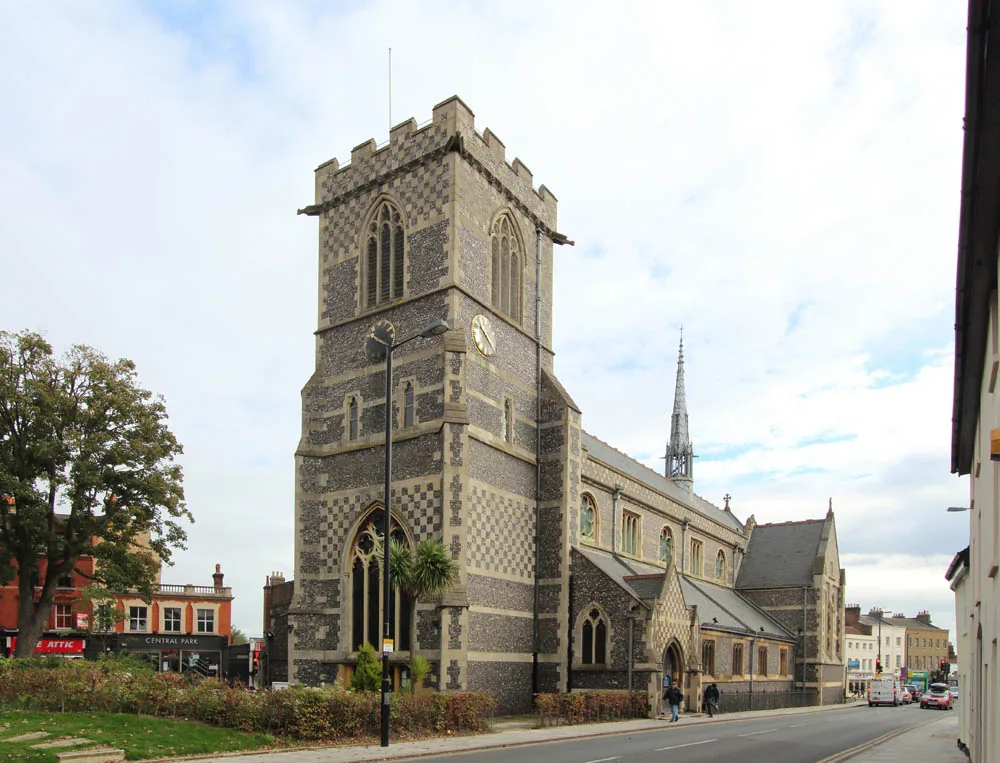
Tree cover in the Chipping Barnet Conservation Area, around Barnet Church and toward Hadley Green is part of the town's character. Development behind the High Street often sits close to garden trees that contribute to that setting. Surface water flood risk should be considered alongside any tree and landscape scheme.
The London Borough of Barnet assesses tree and landscape issues under Policy CDH07 of the Barnet Local Plan 2021–2036, adopted on 4 March 2025, read with Policy ECC07 on biodiversity and the London Plan tree and urban greening policies. The council publishes type-specific validation checklists. Confirm the current local validation requirements with the council before submitting.
Local plan: Barnet Local Plan 2021–2036 (The Barnet Local Plan 2021–2036 was adopted on 4 March 2025 and is the adopted local plan. The London Plan, published on 2 March 2021, also forms part of the development plan. There is no 2027 successor council for this borough.)
CDH07: Amenity Space and Landscaping
Policy CDH07 of the Barnet Local Plan 2021–2036, adopted on 4 March 2025, requires development to provide adequate amenity space and, where hard or soft landscaping is included, to design it sympathetically to local character. Soft landscaping should provide biodiversity benefits such as habitat creation using native species, and an appropriate level of new and existing wildlife habitat including tree and shrub planting, in accordance with Policy ECC07. Existing trees of value should be retained wherever possible. Retained trees must have their stems, canopy and root systems safeguarded. Where trees are removed they should be replaced with trees of equal value and of suitable sizes and species. Where replacement on site to the value removed is not possible, a contribution to the council for any residual value may be made to provide trees in nearby streets and open spaces, secured by a planning obligation. Provision is also to be made for sustainable drainage in accordance with Policy ECC03.
ECC07: Biodiversity
Policy ECC07 requires the retention and enhancement, or the creation, of biodiversity in development proposals. It protects Sites of Special Scientific Interest, Sites of Importance for Nature Conservation, and priority habitats and species. Development is expected to make the fullest contribution to enhancing biodiversity and to protect existing site ecology, including Biodiversity Net Gain in accordance with national policy and legislation. The Environment Act 2021 requires at least 10 per cent biodiversity net gain. The policy does not set a percentage above that national minimum. Where significant harm cannot be avoided, it must be adequately mitigated or, as a last resort, compensated for; otherwise applications will be refused. Developers are also expected to take a holistic approach to biodiversity net gain, the urban greening factor and sustainable drainage.
ECC03: Water Management
Policy ECC03 requires development to be located in areas at lowest risk of flooding from any source, assessed through the sequential test at application stage, and to ensure flood risk is not increased elsewhere. A site-specific flood risk assessment is required for sites of 1 hectare or more in Flood Zone 1, for sites in Flood Zones 2 or 3, for relevant non-householder applications within specified climate-change flood extents, within an identified Critical Drainage Area, and where a site may be subject to another source of flooding and a more vulnerable use would be introduced. Surface water should be managed as close to its source as possible, aiming for greenfield run-off rates and following the London Plan drainage hierarchy, with management and maintenance plans for SuDS. Development beside a river corridor is expected to provide a buffer zone of at least 10 metres.
General guidance for tree survey (bs5837), not formal advice for your site.
The London Borough of Barnet. The London Plan also forms part of the development plan. The borough is the Lead Local Flood Authority. There is no 2027 successor council for this borough.
A tree survey is expected where existing trees of value could be affected, including in the Chipping Barnet Conservation Area and near Barnet Church or Hadley Green. Policy CDH07 requires those trees to be retained and protected wherever possible. Confirm the current local validation requirements with the council before submitting.
Yes. The London Plan, published on 2 March 2021, forms part of the development plan. Policy G7 on trees and woodlands is the London Plan policy most often read alongside a tree survey.
No other published town guides for this survey in the council area yet.